
Science Progresses One Funeral At A Time
The Role of Generational Conflict in Science

‘An important scientific innovation rarely makes its way by gradually winning over and converting its opponents: it rarely happens that Saul becomes Paul. What does happen is that its opponents gradually die out, and that the growing generation is familiarized with the ideas from the beginning: another instance of the fact that the future lies with the youth.’
—Max Planck
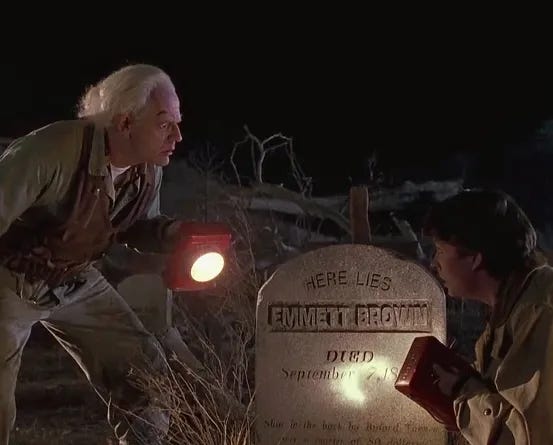
In this post, I want to discuss the role of differing generational perspectives and conflict within scientific progress, particularly in times of scientific crises and revolutions1, and will argue that these differing perspectives are in fact vital to scientific progress.
In my recent post, ‘Should Bayesians Believe In Magic’, I argued that we apply a kind of “conservative” epistemology in the face of new evidence, attempting to accommodate the new evidence in whatever way minimises damage to our present web of beliefs. We must find some way to account for the new evidence, but we actively search for interpretations and further evidence that will allow us to preserve our beliefs as far as possible.
As I argued, this is not merely stubbornness or irrationality, but is in fact a responsible truth-seeking behaviour. Our present credences/beliefs are our measure of what is true, and so they are the final (and only) judge by which to determine how we should update our beliefs in the face of new evidence. We seek truth by looking to maximise unity in two dimensions: internally within our beliefs at any moment, seeking to avoid ambiguity and contradictions, and temporally between our previous and new beliefs, seeking to preserve as much of our previous knowledge as possible while accommodating the new information with it.2
This makes further sense when we consider how our present beliefs represent the results of a very large body of previous evidence. When we attempt to integrate the new evidence with our prior beliefs, we are attempting to integrate all of our evidence, both old and new, into a coherent picture. It would do no good to dispose of a theory which accounts for 90% of the evidence in favour of a theory which only accounts for the latest 10%.
But what counts as “the evidence”, and how do we quantify it? Is it a small and insignificant anomaly that will probably be dealt with by some minor adjustment, or is it a gaping hole in the theory requiring a whole new paradigm? Do we require reform or revolution? I think the answer to this will depend on who we are asking.
We might attempt to quantify the evidence in terms of how surprising/improbable it was. From a Bayesian perspective, the more surprising a piece of evidence is the more evidential weight it has. But what is surprising to one person may be entirely unsurprising to another. Particularly, what is an earth shattering discovery for one generation of scientists becomes page 17 of a dusty textbook for another generation. It is not forgotten, but it does come to be taken for granted.
As an example, Newton’s theory that the motions of the moon and planets is due to the same force that causes apples to fall to the ground was an extraordinary breakthrough, uniting the laws that govern the heavens and the earth! It completely changed our conception of reality. But to us, this is something we learn in primary school. We are so accustomed to the idea that the same laws apply in space and on earth, that we might feel we would have discovered it ourselves, if only we were alive in Newton’s day.
As a result, I believe that older scientists will tend to have a much greater appreciation for the successes of their theories. The apparent outstanding anomalies may fairly appear to them as mere blips which will soon be resolved within the confines of the existing theory, as others have before them. But as anomalies accumulate and the low-hanging fruit of success for the theory gets taken, the anomalies will grow to dominate the scientific experience of the newer generations of scientists. Where the previous generation had the experience of rapid discoveries in a progressive research program3, the new generation has the experience of growing frustration as the program appears to be hitting its wall.
For the generation that enjoyed the theory’s heyday, they had direct experience of the explanatory, predictive, and technological power of the theory. But for the new generation, the theory’s successes are second-hand ideas, transmitted via textbooks and reproduced experiments, but without the original freshness and force of science on the cutting edge.
As a result, the older and younger generations are likely to appraise the present state of the same theory and the same experimental findings very differently. Neither needs to be unaware of any piece of evidence, old or new. But because of their different historical experiences as scientists working on the theory, they are likely to view its successes and difficulties very differently.
Does this mean the older generation are underestimating the significance of the anomalies, or that the new generation are underestimation the significance of the theory’s successes? I do not think so. There is, I believe, no perspective-independent measure of significance for a piece of evidence: it is always relative to our expectations, wider beliefs, and experiences.
But this is not a weakness. We cannot escape our perspectives in order to perceive reality from a perfectly detached “view from nowhere”. But we can instead utilise our multiple conflicting perspectives in order to form a more complete picture. We “triangulate” between different points of view, like how our two eyes provide us with the perception of depth. Knowledge does not come from finding the one correct point of view, but from the dialectical back and forth between conflicting perspectives and ideas.
The conservative perspective of the “old guard”, seeking to preserve and retain theories that have proved so successful, is necessary. It prevents us from prematurely discarding decent theories, and it sets the bar for new theories to overcome. And the revolutionary perspective, questioning and challenging received wisdom and offering new ways forward, is similarly necessary. It prevents us from remaining stuck in the dogma of the past, and allows for novel solutions and ideas.
The two generations represent two essential elements of science. The older generation, with their wisdom born of experience, represents induction. The old theory has worked so far, and we should stick with it. The younger generation, with their hunger for new and better solutions, represents imagination. The new theory may have worked OK up until now, but a better theory is possible! The old look backwards at what has been and the young look ahead to what might be.
We might say that the older generation bring their knowledge and experience and the younger bring their ignorance and imagination. It is their lack of experience that characterizes their perspective. But in being good scientists, they must think and act from their own perspectives, daring to question and challenge the received wisdom. We are each born in ignorance of the world and as we learn and engage with reality must question, challenge, and attempt to improve upon the ideas that are handed down to us.
In this way, ignorance turns out to be the driver of new knowledge. We are born in complete ignorance — a brand new perspective on the world. If we could download the mind and experience of those who came before us, we would lack the open intellectual space in which to see things anew.
The progress of science requires the accumulated knowledge and wisdom of those who have come before us, but it also requires the fresh start given in each new generation, giving us the opportunity to look at the world with fresh wonder and new eyes. Progress does not result from clinging to what we know, nor from blindly chasing after new ideas, but from the creative dialectic between the old and the new, between experience and imagination.
In science, as in life in general, aging involves the necessity of “passing the baton”. Each generation must do its part and acquire and pass on what knowledge it can, but this must then be entrusted to the next generation to take up the task anew.
“Science progresses one funeral at a time.” Yes, and one birth at a time too.
h/t Thomas Kuhn
The link between knowledge and unity has an interesting similarity to the link between morality and unity, which I argued for in my last post.
h/t Imre Lakatos
I liked this! Agreed that it isn't irrational, and is in fact a strength of science, that you can have varying degrees of "conservativeness". People change their minds, but it isn't rational to change everything at the drop of a hat.
One thing your take on the generational difference made me think: With Bayesian modeling, you often run the sampling algorithm to generate the most likely parameters. But then, to make sure you hit on a robust set of parameters and not just a local minima, you often restart at a new seed location to see if it converges to the same spot. If the sampling converges no matter where you start it, that's good evidence of a robust, singular solution to the problem of finding the parameters.
So you can imagine the new generation as new seeds, each looking around for new solutions. If they all converge on some new theory, that's good evidence that a new theory is robust! If they all come up with different new theories, maybe the data is just ambiguous. If most converge to the old, it's a good sign the old theory is still pretty robust.
Loved it mate!