
The Mind-World Klein Bottle
How the mind contains the world and the world contains the mind

Introduction
There is a paradox in the relationship between our minds and the external world. We believe that our minds/brains exist in the midst of the wider world we experience around us. This is intuitively obvious, and is also what science tells us. On the other hand, we also believe that the world we experience exists within our brains/minds. Neuroscientists tell us that the world we experience is a “controlled hallucination” within the brain. The paradox is simple: the mind exists within the world, and the world exists within the mind. The world contains the mind contains the world.
A related point is that the mind contains itself. That is, amongst the concepts that make up its world, the mind finds itself.1 If it did not contain itself, we would not be able to speak or even think about our minds. But how can a thing contain itself?
Physicalists tend to emphasise that the mind exists within the physical world, and therefore must be physical. The mind therefore cannot really contain the world, only a concept of it. Or not even that, according to the most radical eliminative materialists, who would deny mind entirely. Dualism is similar to physicalism on this point, seeing the mind as only containing a mental representation of the world on a kind of “screen of perception”. Idealists meanwhile tend to emphasise that the physical world we experience exists within the mind, and so must be mental. The world therefore cannot really contain the mind or be external to it, it only appears as if it is. The physical world is only a mental image, an illusion. Either way, we are severing the inner world of experience from the external world.
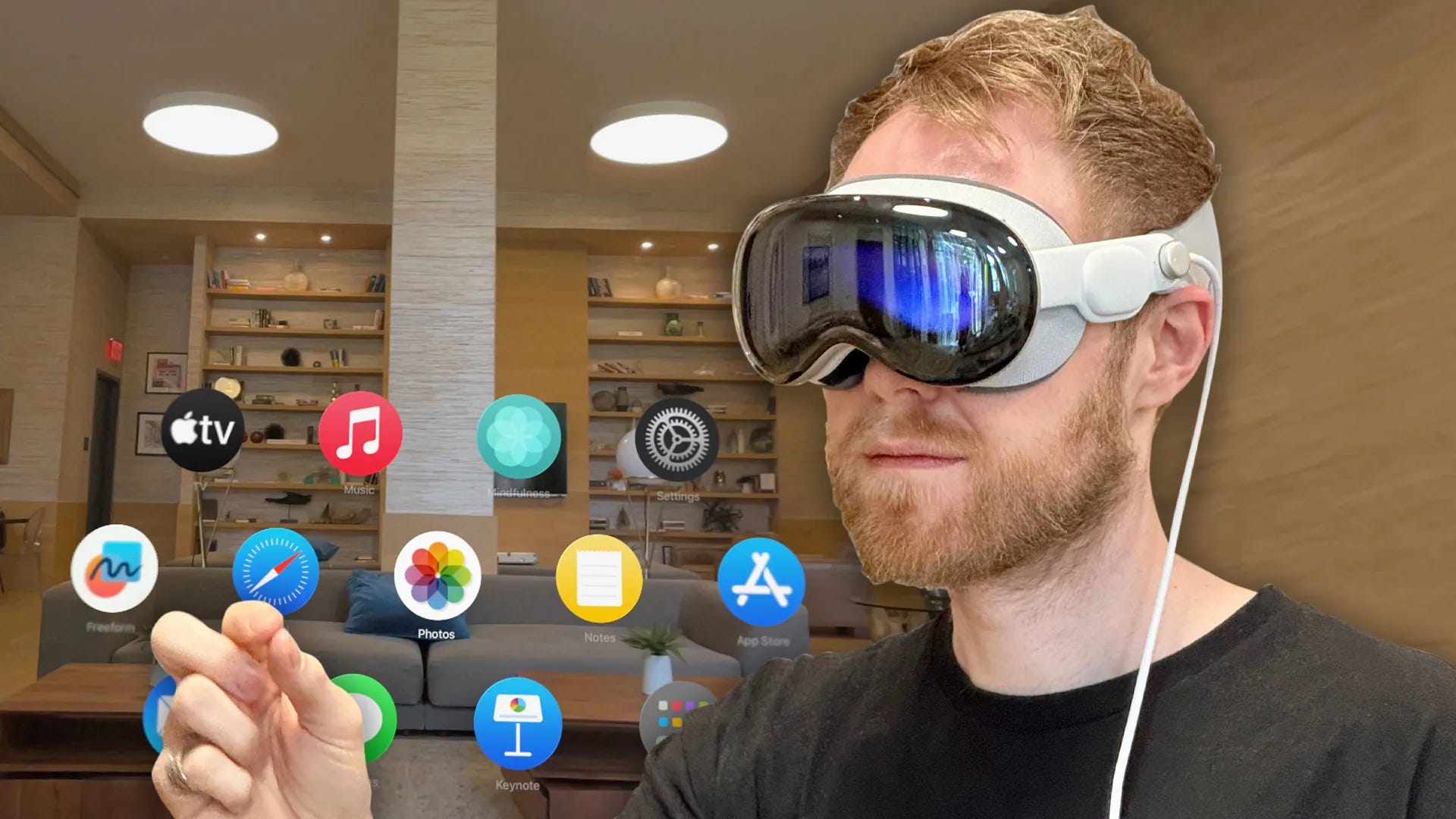
The problem with these physicalist and dualist approaches is, if all we have is a mental image of the world, how are we supposed to go beyond that to know the external world. How are we to know that we can trust our senses, when we have nothing but our senses to validate them by? We seem to be trapped in scepticism concerning the external world, which might then motivate a turn to idealism. And the problem with idealism is simply that it denies the external world. The first thing given to us in experience, before we even have a concept of experience itself, is that we are experiencing a world outside ourselves. Idealism rejects this.
So, how can we resolve this tension? How can the mind contain the world contain the mind? How can the world inside our heads be the world outside our heads?
Klein Bottles
So far we have been implicitly thinking as if the “inner world” of the mind and the “outer world” of physical reality are perfectly separated, like the inner and outer surfaces of a hollow sphere, with no way to move from one side to the other. I propose that we instead think of the situation as more like the surface of a Klein bottle.
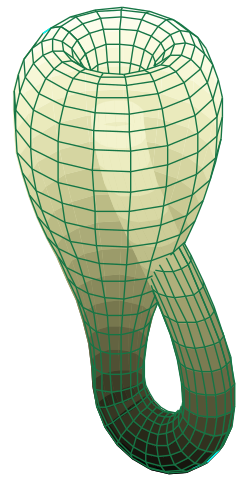
A Klein bottle is a 4 dimensional shape with zero edges and only one side, formed by “gluing” the edges of two mobius strips together. For any point on the Klein bottle, if you look at the “opposite side” of the surface, you will find a point that is in fact on the same side. Its inside and outside are continuous with one another. They are the same side.
I want to suggest that we accept the paradox of the mind containing the world containing the mind. Mind and world are different, like the opposite sides of a Klein bottle, but they are also the same, like the single side of a Klein bottle. Rather than a separate mental inner world set against a physical external world, there is a single mind-world (Bewusstseinswelt), folded back on itself in such a way that it truly contains itself. It is both two and one, dualism and monism.
Direct vs Indirect Realism
As part of this, we need to reject the simplistic indirect/representationalist realism which says that we do not perceive the external world, but only an internal representation of the world. The first problem with this idea is that it is unclear how we are meant to perceive these inner representations. How do we perceive the screen of perception? Do we need another screen?
The other issue is that it represents a misunderstanding of what both representation and perception are, assuming that representation is an obstacle to perception and that perception is only real if it is immediate. I think this is backwards. Perception is always perception through.
I wear glasses, and we might view my glasses as rerouting the trajectory of the incoming light so as to form a 3D image for me to view, like a sort of ongoing hologram just for me. Am I viewing this hologram instead of the objects represented by it, or am I viewing the objects through my glasses? For that matter, do we see light instead of visible objects, or do we see visible objects via the light they reflect?
It is true that our experience of the world is mediated by complex sensory and mental processes. But mediation does not cut us off from the thing mediated, but the exact opposite. My glasses mediate my vision of the world, they do not obstruct it. Our telephones let us speak to distant people. Our X-ray machines let us look at bones. It is through the mediation, through the re-presentation, that things are genuinely made present to us.2 And if this is true of glasses, how much more true is it for our senses and the processes in our brains that make perception possible at all?
It is also not clear where we should say that this mediation begins or ends. In Metazoa3, Peter Godfrey-Smith talks about how fish have lateral lines along their sides that act as a kind of “extended sense of touch”, sensing not just what touches them directly, but using the water itself as an extended sensory system. Some spiders detect minute vibrations using their webs, and even use these vibrations to communicate. For ourselves, the light by which we see the world is already acting as a mediator between ourselves and visible objects. And while driving, our cars become an extension of our bodies, not just in terms of our actions but also extending our perception, so that we may, for example, sense a small bump in the road through the car.
What is it that gets transmitted to us then? Obviously it is not the material of the objects4. It is something more like the patterns, relational structure, or information regarding the thing. In Aristotle’s terms, it is the form, not the matter, of the object that is transmitted through the medium to our minds. Whatever language we choose, the point is the same. In the ways that count, we are truly perceiving the world.
You might be wondering, why did the world-structure fold back on itself like this? Why is the mind-world a Klein bottle? The answer to this lies in the evolution of life and especially of minds, and would be too much to go into here. Evolution is itself already a self-referential process of the world modelling itself, which I have discussed briefly here and mean to discuss more in future posts. (If you are interested in the evolution of minds, I recommend ‘From Bacteria to Bach and Back’ by Daniel Dennett.)
Conclusion
As strange as a Klein bottle mind-world may sound, it allows us a view that recognises core motivating insights of physicalism, idealism, and dualism, all at once. The physical world does contain the mind. The mind does contain the physical world. Mind and world are distinct. Mind and world are continuous with one another.
We did not resolve the paradox of how the mind contains the world contains the mind, we embraced it. And in doing so we gained a picture of the world that allows us to have genuine knowledge of the world. Not as something apart from ourselves or a “world-in-itself”, but as the world in relation to ourselves, in continuity with ourselves. We can know the world because we are in it and it is in us. We are the world folded back on itself.
Bonus: Video on Klein Bottles!
There’s a fun similarity between this and the idea of the incarnation in Christian theology. I’ll probably not explore this further because I’m no longer Christian, but I’d be interested to see where others might take it.
This is a point I picked up from Catholic sacramental theology. In Catholicism, God is truly present to believers through the Church and its sacraments. Before I was a Catholic I was a protestant, and in protestant circles mediation is seen as bad, as if mediation is always an obstacle rather than the opposite. I much preferred the Catholic approach.
Which I read as part of Tommy Blanchard’s book club, which is great by the way and I recommend joining and subscribing to Tommy if you don’t already.
Although not that obvious — one ancient theory of vision was that material things continually shed thin films (eidola) which enter our eyes.
Interesting idea. It reminds me of Chalmers' speculation about a possible infinite regress of simulations that actually loop back into each other.
It seems like there are actually two type of relations here, containing and reference to. Under physicalism, the world contains the mind and the mind has references to the world. In (some forms of) idealism, the mind contains the world, but the world contains references to the mind.
But under some idealisms, there is a world out there outside of our own minds, just not a physical one, which complicates both the view you're describing and the ones I just described. For example, in subjective idealism, the world out there is within the mind of God, or a universal spirit of some kind. In that case, maybe the world contains *our* minds, but God's contains the world.
There's also the concept of recursion in computer science. Both the mind and world can self reference each other in self referencing loops. That seems to allow for a certain level of agnosticism about whether we're dealing with containment or reference.
I think a lot of philosophy is hunting for good analogies and this is a fantastic one.